9 min to read
How continuous blade monitoring and drone inspections work together for smarter wind turbine maintenance
Published: December 18, 2025
Updated: December 19, 2025
Table of content
In wind energy, operators increasingly seek to shift from periodic inspections to data-driven, condition-based maintenance. Two technologies now sit at the center of this transition: continuous monitoring systems and drone-based inspections. Although often viewed as separate tools, their real value emerges when they operate as a unified diagnostic and decision-support ecosystem. While continuous monitoring tracks the condition of the turbine in real time, the data can often only be used as an indicator of damage. Drone inspections are used occasionally to provide a detailed evaluation of the condition of the blades.
Continuous monitoring as the primary diagnostic layer
Modern continuous monitoring systems collect real-time data on the mechanical, structural, and environmental conditions of wind turbine components. For blade monitoring, sensors typically focus on parameters such as surface condition, vibration patterns, aerodynamic disturbances, and icing events. These sensors operate in all weather conditions, providing a persistent, high-resolution signal that captures both sudden anomalies and long-term degradation trends.
What makes this layer valuable is not only constant data acquisition, but the ability to detect subtle changes that precede visible damage. Small aerodynamic disturbances may signal early-stage leading-edge erosion. Ice accretion can be detected before it becomes visually noticeable or causes severe performance losses. Continuous monitoring provides early awareness, creating the first indication that an inspection or intervention may be required.
However, sensor data alone cannot always identify the type of damage or its exact location. Operators know the turbine is behaving abnormally but need visual confirmation to determine severity, root cause, and the appropriate maintenance response.
Drone inspections: The high-resolution localization layer
Drone inspections fill this gap by offering high-resolution, targeted visual assessment. Once a monitoring system detects anomalies, drones can be deployed – either on demand or during the next scheduled inspection window – to verify the sensor signals and locate physical defects on the blade surface. The drone imagery confirms whether an event corresponds to early erosion, lightning strike marks, trailing-edge cracks, coating defects, or any other issue affecting a wind turbine’s performance.
To achieve this level of accuracy, wind operators often rely on established drone-inspection partners such as Aerones or SkySpecs. Both companies provide visual inspection, consistent image capture, and high-quality photo data optimized for comparison over time. Their repeatable inspection workflows ensure that images are captured under consistent angles and distances, allowing operators to verify how a defect evolves from one inspection cycle to the next.
In addition to visual data, thermal and multispectral imaging can reveal subsurface anomalies, moisture ingress, or delamination—areas where visual damage may be minimal, but structural progression is underway. This complements the monitoring system’s event detection by providing a clearer understanding of the asset’s condition.
Unlock practical insights into blade damage detection
Dive into the definitive guide to blade damage detection. This whitepaper helps you understand environmental stressors and structural risks, evaluate damage detection technologies, and implement continuous monitoring strategies that save time and money - supporting a more resilient and efficient wind farm.
How monitoring data and drone imagery form a unified diagnostic workflow
When continuous monitoring and drones operate in isolation, each provides partial insight. When combined, they form a closed-loop workflow that improves reliability and operational efficiency.
Continuous monitoring establishes the temporal context. It tells operators when something changes, how fast it is progressing, and under which conditions the disturbance occurred. Drone inspections provide the spatial context by showing what changed and where the issue is located on the blade.
The typical workflow looks like this:
- The monitoring system identifies an abnormal signature – an acoustic disturbance, vibration shift, or sudden performance deviation.
- Operators review historical sensor data to determine whether the anomaly is transient, repetitive, or rapidly intensifying.
- A drone mission is executed to localize and visually characterize the defect.
- Imagery and sensor data are correlated to determine the damage type and extent.
- Maintenance is scheduled according to actual conditions rather than fixed intervals.
This workflow supports condition-based and predictive maintenance, reducing unnecessary inspections while ensuring emerging issues are caught early enough to prevent costly failures.
Real-World example: Tracking lightning damage with continuous monitoring and drones
A recent case in the US involving Blade A shows how combining continuous condition monitoring with periodic drone inspections provides a more complete understanding of damage development.
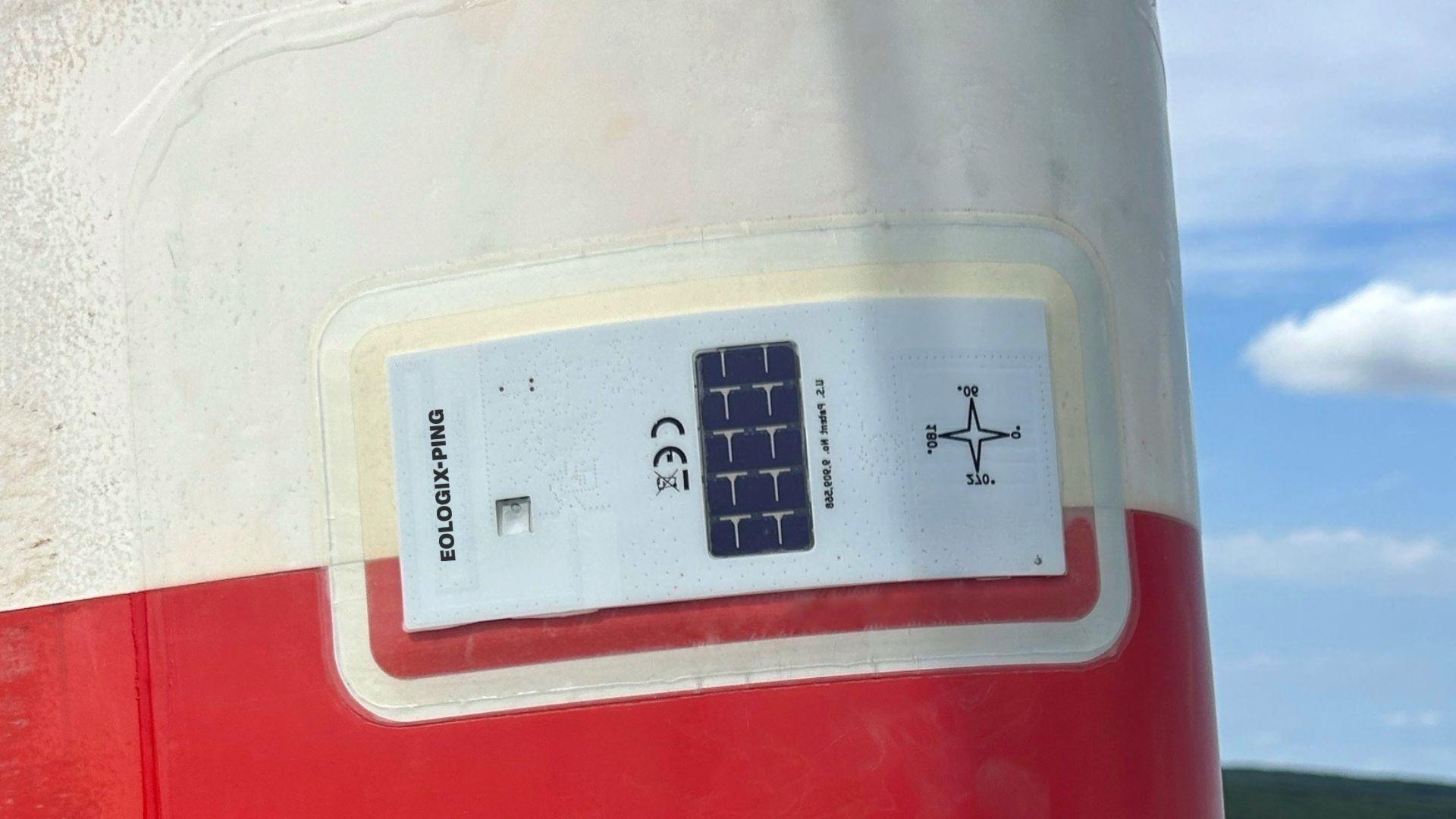
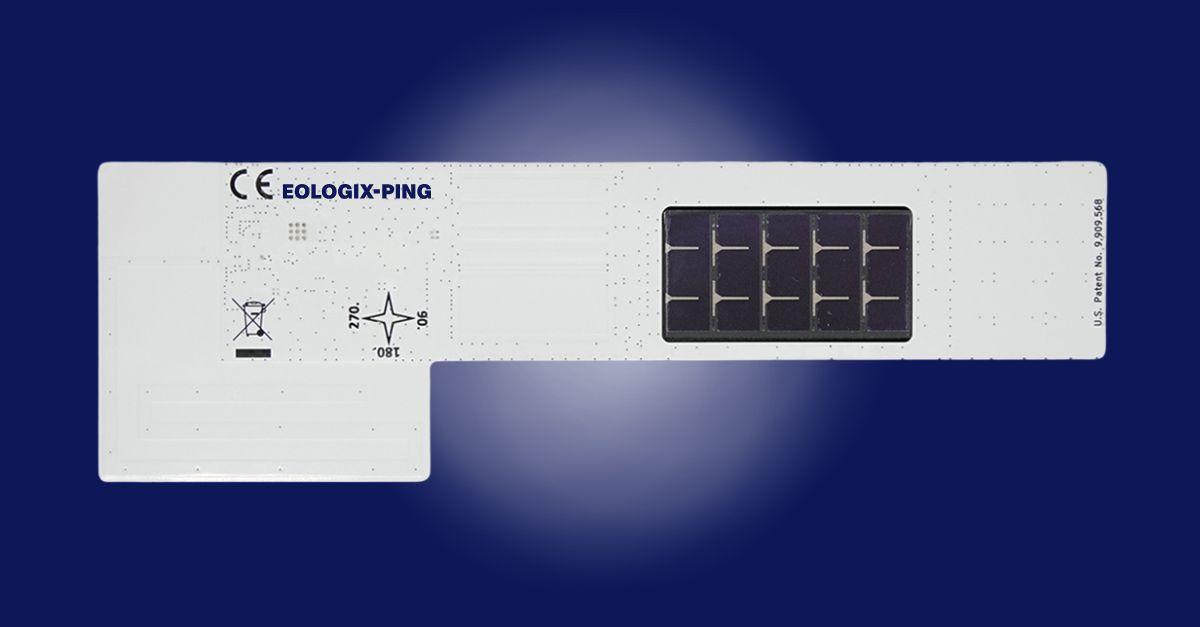
Our :SURFACE HEALTH monitoring system was used to continuously track the progression of a known lightning strike defect. The system detected subtle changes in the surface condition over time, signaling that the damage was still apparent. These indications were later confirmed and quantified through scheduled drone inspections.
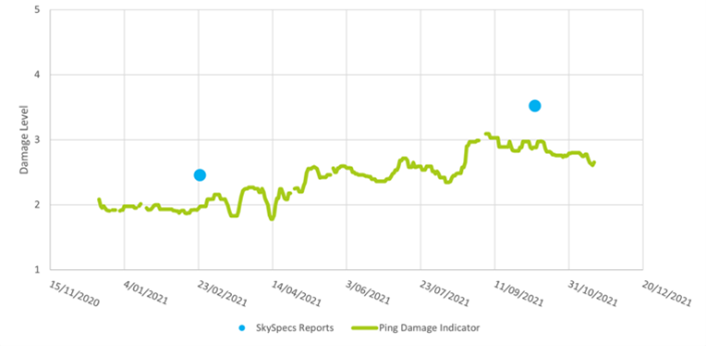
Damage indicator trend from continuous monitoring system
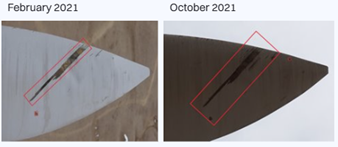
Progression of CAT4 Lightning Damage on Blade A (Feb–Oct Drone Comparison)
When comparing the February and October drone reports, the worsening of the defect became clear. The CAT4 lightning damage on Blade A increased in width from 10 cm in February to 20 cm in October. This progression is visible when comparing the February (left) and October (right) drone photographs.
This example demonstrates how real-time monitoring and visual drone inspections complement each other -monitoring alerts operators to ongoing changes, while drone imagery provides precise measurements and visual confirmation needed for maintenance planning.
How data correlation improves predictive accuracy and damage classification
The integration of continuous monitoring and drone inspections does more than provide complementary evidence; it strengthens predictive models. Monitoring systems generate continuous time-series data, while drone inspections contribute discrete but high-fidelity snapshots. When these datasets are correlated, operators gain insight into how specific damage types influence sensor signatures.
Over time, this relationship enhances machine learning models used for damage classification and prediction. It allows continuous monitoring systems to forecast damage progression with increasing precision, even before the next drone inspection is performed. The results of drone inspections provide labeled data that can be used to analyze which patterns in the data correspond to which types of damage. This in turn means that similar structures can be more easily assigned to the respective damage in the future.
Operational impact for wind turbine owners and O&M teams
For wind asset owners, the combined approach yields operational benefits that extend beyond diagnostics. Reduced downtime, fewer manual climbs, faster root-cause analysis, and improved repair planning directly influence OPEX. More importantly, operators gain the ability to detect issues in weather windows that drones cannot access, while drones capture high-quality data during suitable conditions.
This combination ensures that no single technology carries the full burden of monitoring. Instead, operators gain a multi-layered inspection strategy, where continuous monitoring provides uninterrupted coverage, and drones deliver targeted verification and documentation.
Conclusion: A multi-layered strategy for predictive blade health management
Continuous monitoring and drone inspections are not competing methods but mutually reinforcing tools. By merging real-time sensor intelligence with precise visual diagnostics, wind turbine operators build a comprehensive understanding of blade health. This hybrid approach improves maintenance accuracy, supports predictive strategies, and minimizes both cost and downtime. As AI-driven analytics and autonomous drone systems advance, the synergy between continuous monitoring and drone inspections will only deepen – moving the industry toward fully integrated, automated blade health management.
Share this blog post


Similar blog posts


Subscribe to our newsletter
Stay informed with the latest industry news, fascinating insights, and updates from EOLOGIX-PING delivered straight to your inbox.
PS.: We promise no spam.